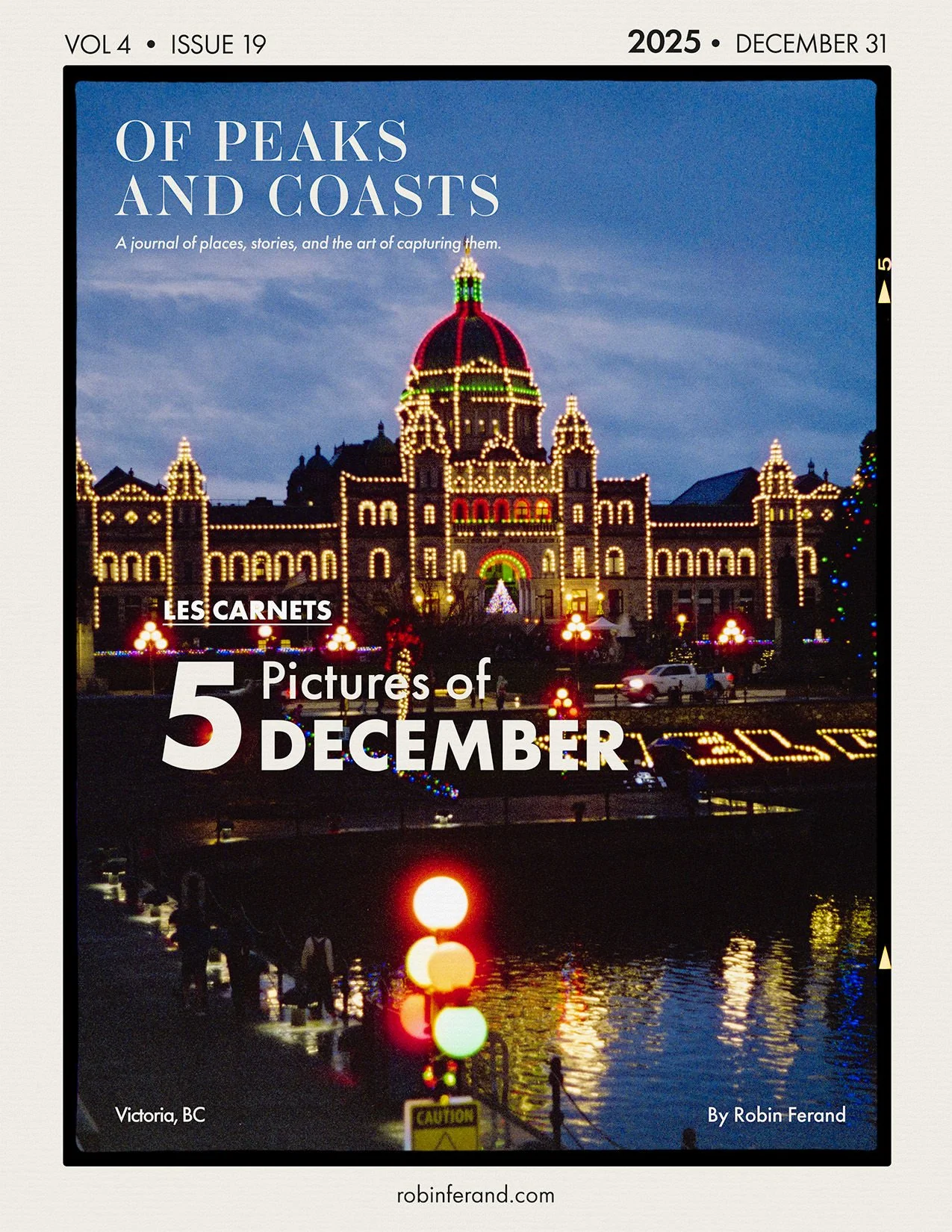
5 Pictures of January

J
anuary has always been a dry month for me.In France, we have this tradition (and I’m sure other countries do too) called “Dry January”: a month without alcohol after the holiday season.
For me, it’s not alcohol but photography that follows a similar pattern. It’s not intentional, yet I often find myself shooting very little in January. The weather plays a big part, and I’m usually busy wrapping up projects from the previous year so I can, at least in theory, start the new one with a clean slate.
So I didn’t get out much this month, apart from a few beautiful days breaking up the heavy fog that settled over Vancouver Island. Here are my favourite photographs from January 2026, arranged deliberately this time, with my top image saved for last. Let’s dive in.
V) Separation, Nanaimo BC
2026 • January 24 | Nanaimo, BC
24mm f/1.8 - 1/15s - 260ISO
I recently returned to aerial photography after a few years’ hiatus. During a training flight, I noticed on the drone’s belly-mounted sensor camera a peculiar stretch of trees that stood out for their height, girth, and contrast. Intrigued, I stopped, hovered, and switched the main camera to a top-down view.
Because the secondary cameras display a monochrome feed and that was what first caught my eye, I initially planned to develop the image in black and white. But once in Lightroom, I realized the many shades of green made the photograph much more compelling.
Shot on Dji Mini 5 Pro
IV) Cobra Chickens in the Fog
2026 • January 19 | Wheat Regional Park, BC
100mm f/2.8 - 1/120th - 100ISO
In mid-January, a strong inversion settled over Vancouver Island and even Vancouver, shrouding everything in thick fog for days and prompting a fog advisory. Looking back, I wish I’d gone out more that week to photograph the weather, but I was busy editing and only managed to steal an hour to drop by Wheatcroft Park near Pipers Lagoon to witness the fog.
When I arrived, there wasn’t much to see at first, just the ghostly outline of Pipers Lagoon’s rugged shoreline mirrored in the still water. I sat on the pebbly beach, listening for the distant ferry horn, when another sound cut through the quiet: a much closer, sharper honk from a familiar Canadian resident, the so‑called “cobra chicken.” I turned to my right, trying to discern where the water ended and the fog began. A few seconds later, two long black shapes slowly emerged from the mist, gliding across the surface and rippling the glassy water.
I had one of my film cameras loaded with colour film, but I knew this scene needed monochrome, so I reached for my iPhone 17 Pro and edited the image with a personal emulation of Ilford HP5.
Shot on iPhone 17 Pro
III) A Heading in the River
2026 • January 4 | Parksville, BC
24mm - f/1.8 - 1/15th - 100ISO
It was the maiden flight with my new DJI Mini 5 Pro drone. Nothing spectacular happened that day, just a simple flight above the river to get back into the flying groove. I started with the usual aerial shots of the river slithering through the trees, then shifted the camera to a top-down perspective and spent the rest of the flight searching for interesting compositions.
Top-down views have always fascinated me; they’re a great way to highlight the patterns and shapes in the landscape. From above, I noticed a fallen tree resting in the shallows of the river. It looked like the needle of a clock or even a compass, and amusingly, it pointed almost perfectly west. I eventually rotated the image 90 degrees so it now appears as if a lone tree is standing on the downslope of a hill. Yes you have to imagine it slightly.
Shot on DJI Mini 5 Pro
II) The Result of a G4 Geomagnetic Storm above the Salish Sea
2026 • January 20 | Nanaimo, BC
24mm - f/2.8 - 5s - 4000ISO
In the third week of January, the Sun released a massive solar flare, triggering a G4 geomagnetic storm on the NOAA scale. I don’t know much about space weather; I mostly rely on what my Auroras app tells me. On the evening of January 20, it kept sending notifications that northern lights were developing above Vancouver Island and across much of the Northern Hemisphere.
After dinner, we drove to Neck Point and waited on the rocks for a green hue to appear in the sky. If you’ve ever seen the northern lights in a place where they’re usually absent, you know that what you see with the naked eye is nothing like what the camera can capture. A faint green haze on the horizon can look spectacular in a photograph.
That evening started hazy and unpromising. I took a few shots, but nothing close to what I had experienced the previous year nearby. I was about to pack up when we noticed the famous “dance” slowly glimmering above the Sunshine Coast. Within seconds, it grew stronger and brighter shifting into a natural spectacle so captivating it didn’t require us to glance at the back of the camera.
We watched for another hour. I captured more images, but this one is probably my favourite: the iconic view of Neck Point at low tide, crowned by dancing northern lights in shades of purple and green. If you look closely, you might spot the heron fishing in the shallows. I spent a while capturing closeup shots of him under the green sky.
Shot on Canon R5C
I) A far-away breach is still a breach
2026 • January 4 | Nanoose Bay, BC
560mm f/9 - 1/2000th - 2000ISO
After a few years of living on Vancouver Island, I’m still glad I follow one simple rule I gave myself: always keep my camera bag ready in case whales are near. So when I heard that a pod of transient orcas was hunting in Nanoose Bay, close to shore, I grabbed my camera bag and ran to the car, heading straight there.
Once we reached the shoreline, we joined a growing group of orca enthusiasts scattered along the coast, eyes behind binoculars and long lenses as they watched the pod. The orcas were still actively hunting, spy-hopping, tail-slapping, and even breaching after a successful kill.
After four years on Vancouver Island, I finally managed to photograph an orca breach. Even though the whales were still fairly far out and I had to use an extender, a long lens, and then heavily crop the image, I still captured the moment. At the end of the day, even a small breach is still a breach.
Shot on Canon R5C
Final Thoughts
These are my favourite photographs taken in January. What lesson did I learn? Maybe just this: even if a month looks “dry” in terms of how many photos you take, and even if you don’t feel you’re in the groove of shooting, keep your bag ready, because you never know when a whale might show up, or when one of the strongest S4 solar radiation storms seen in over 22 years might light up the sky.