Last month of the year.
Usually, December rhymes with snow, yet here on Vancouver Island, it brought rain, fog, wind, and the kind of long storms that keep the power out and the windows whistling. Days blurred together under low clouds, and my cameras stayed home more often than not since I did not feel like spending more time wiping the lens than shooting. But when the sky finally broke, and light came fast and brief even for a single hour before sunset, I thought it was enough to turn the day around.
Most of these photographs came from a short mid-December trip between Nanaimo, Galiano, and Victoria. Though small by distance, the journey was filled with movement; float planes, ferries, and winding along narrow roads. Along the way, there were small discoveries, the kind that remind you why you keep carrying a camera (or more).
I) Neck Point Park
2025 • December 6 | Nanaimo, BC
24mm f/1.78 - 1/60th - ISO250 | Apple ProRAW
After a week of unbroken rain, sunlight burst through, hitting the wall of my office/storage room. The light was pale, yet somehow golden, if that’s even possible. I acted on impulse, grabbing my bag and driving to Neck Point Park before clouds rolled back in. A sharp wind warned of rough weather ahead; you could feel the salt on your face. Still, the air was clean after so many still days spent indoors.
I hadn’t been to Neck Point since August. Not much had changed, except for the new parking lot, which, despite its novelty and space optimization, was almost full. Everything was familiar: the rocky trails, the smell of dried kelp, the sudden flash of gulls. It’s one of those parks that holds both sunrise and sunset in its palms. You can walk its forest paths in near silence, then step out to the shore and see whales moving in the distance. One of my favourite parks in Nanaimo.
I cut through the trees, crossing paths with a familiar local figure: the woman who hand-feeds rabbits like a Disney princess, carrots in her bag, a flock of long-eared followers at her feet. The scene would’ve been perfect for a storyboard, but thankfully, no one started singing.
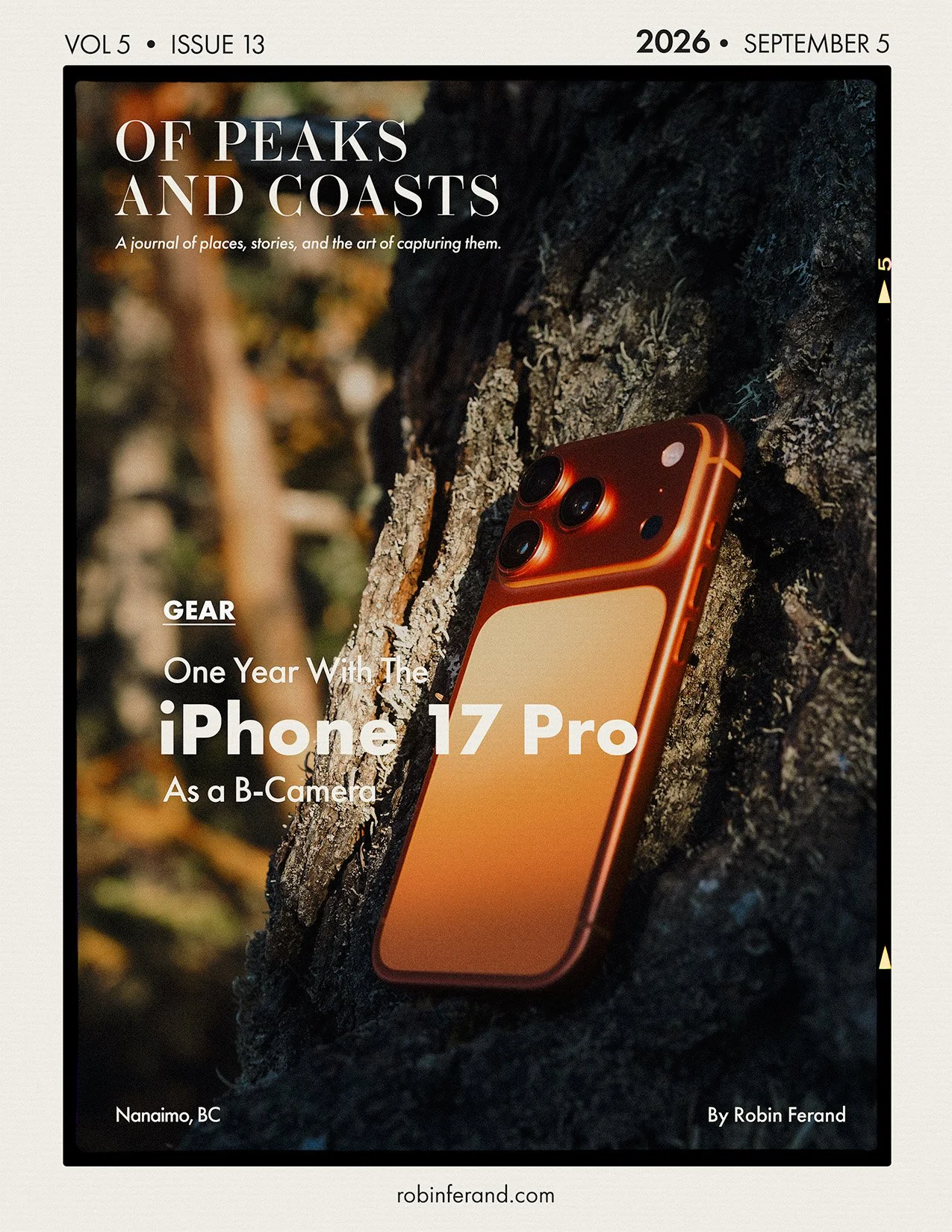
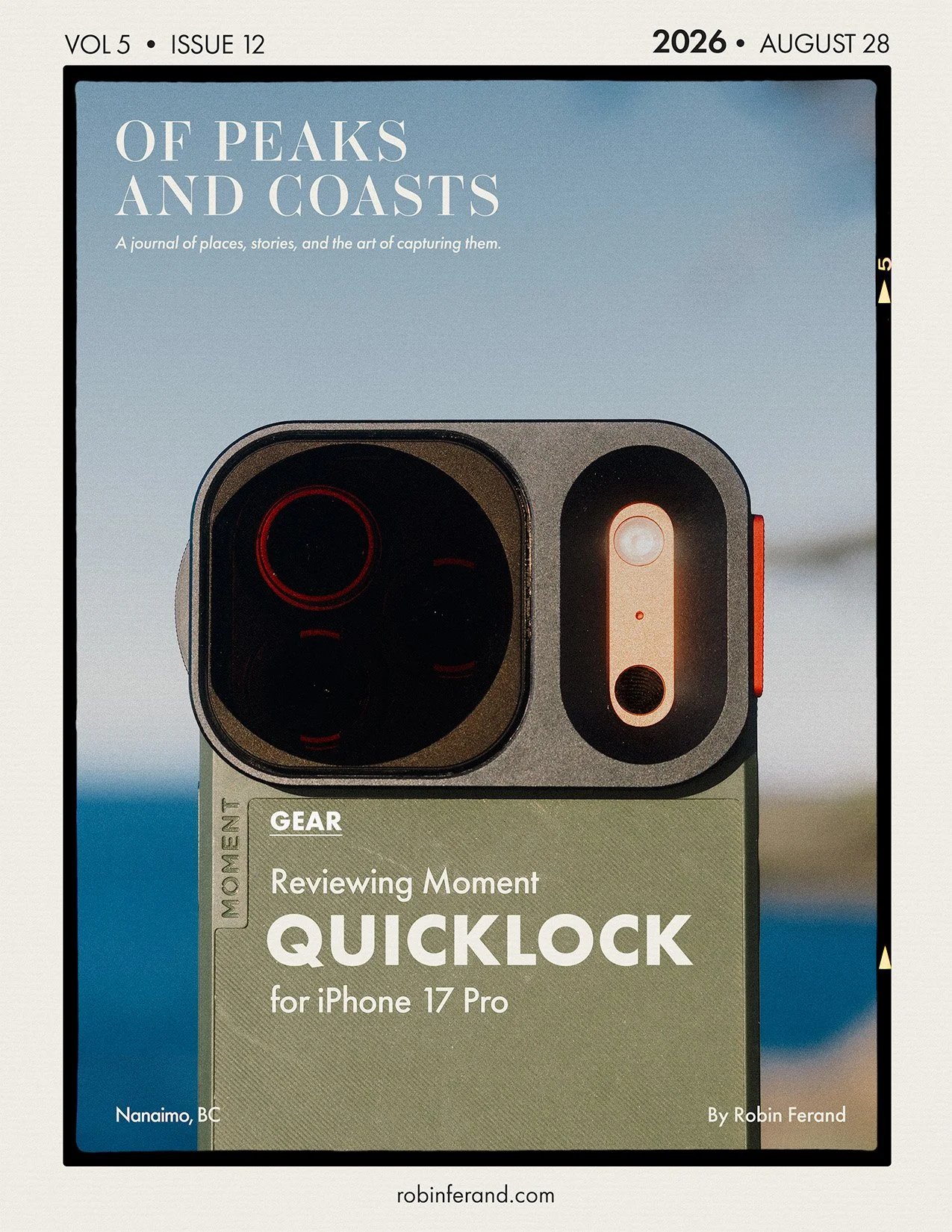
What I really wanted, though, was to test the new Moment QuickLock filters for the iPhone 17 Pro. I’d waited two months for the CPL (circular polarizer) and VND (variable neutral density) filters to arrive. Funny story, I even pre-ordered them a few days before the iPhone 17 Pro pre-order opened, and yet they were delayed. But it’s easy to understand why Moment had to fully reengineer these two filters to work with this new iPhone, and it’s not like Apple shares the schematics beforehand. I had dreamed of such a minimalist approach to mount CPL and VND filters since the days of 2018, when I’d mount a full-size 82mm VND filter in front of my iPhone X.. While it worked, it also defeated the purpose of the iPhone being this powerful little camera that fits in your pocket. Living on the coast, the CPL filter is by far my most-used tool, indispensable for taming reflections on wet rock or in shallow tide pools.
As blue hour crept in, I crouched by a large puddle where a fence mirrored perfectly in the water. Through the ultra-wide lens, the wooden rails curved around like a frame wrapping itself. I dialled the CPL halfway, balancing reflection and sky. That’s when I noticed an odd rainbow ring appeared at the centre. I thought it was glare, so I took another shot with the standard lens. The ring vanished. Side note: It still amazes me how fast I can go, 13mm to 200mm is a split second using the iPhone.
I edited the series twice and preferred the monochrome version; colour added little. I gave it a selenium tone, like baryta paper, which suits my usual monochrome work.
Shot on iPhone 17 Pro
II) Nanaimo River Canyon
2025 • December 7 | Nanaimo, BC
Shot on Olympus OM-2 - 28mm f/2.8 - Cinestill 400D +1
The next afternoon, the rain relented again, and we headed east of Nanaimo to choose our Christmas tree. Since moving to Vancouver Island, that trip has become somewhat of a ritual, usually done in a downpour or plowing through snow. This time, we avoided the rain, and it felt great not to be soaked and sticky with tree sap.
Before the farm, we took a detour down a narrow path into the Nanaimo River Canyon. It was quiet enough to hear the slide of water across moss and the faint call of a bald eagle hidden in the fog. Each step released that sharp Pacific Northwest scent of wet pine, and all around, the deep evergreen contrasted against the mist.
The canyon revealed itself between lapses of shifting mists. Trees appeared and vanished again within seconds, like a film spool running too fast. When the sun dropped behind the trees, its remaining light cast an orange halo strong enough to light both the corner of the sky and the stream below. I took a frame with my Olympus OM‑2, metering for the shadows. The negative came back dark, underexposed even after I pushed it a stop. It’s not the first time, and I’m starting to think that the camera’s aging meter may be lying to me, but even so, the photograph kept the mood I remembered: dark and moody. After all, it was hard to expect light and airy from such a scene.
III) Aboard BC Ferries
2025 • December 14 | Active Pass, BC
Shot on Olympus OM-2 - 50mm f/1.7 - Cinestill 400D +1
After filming a wedding proposal for a friend of mine, I found myself aboard one of those long sailings between Galiano and Swartz Bay that wasn’t direct, instead leapfrogging from Pender and Mayne Island. But this meant for a most scenic line, winding through Active Pass with the Gulf Islands rising on either side.
After eight years in British Columbia, I still can’t stay inside a ferry cabin. The sundeck calls, even in wind or rain. You never know what might surface. My first crossing in 2012 brought a resting humpback, and ever since, I’ve kept watch from the rail.
No whales this time. Just the rhythm of the ship cutting through green-grey water. I drifted from bow to stern with the camera, catching the metallic gleam of the empty sundeck.
I shot the scene on both film and digital. The monochrome conversion worked quite well, but I chose the colour frame in the end, maybe because of the warm glow in the highlights shining on the cold blue metallic tables and chairs, or perhaps the red halation characteristic of any Cinestill stock.
IV) Victoria at Dusk
2025 • December 14 | Victoria Downtown
Shot on Olympus OM-2 - 50mm f/1.7 - Cinestill 400D +1
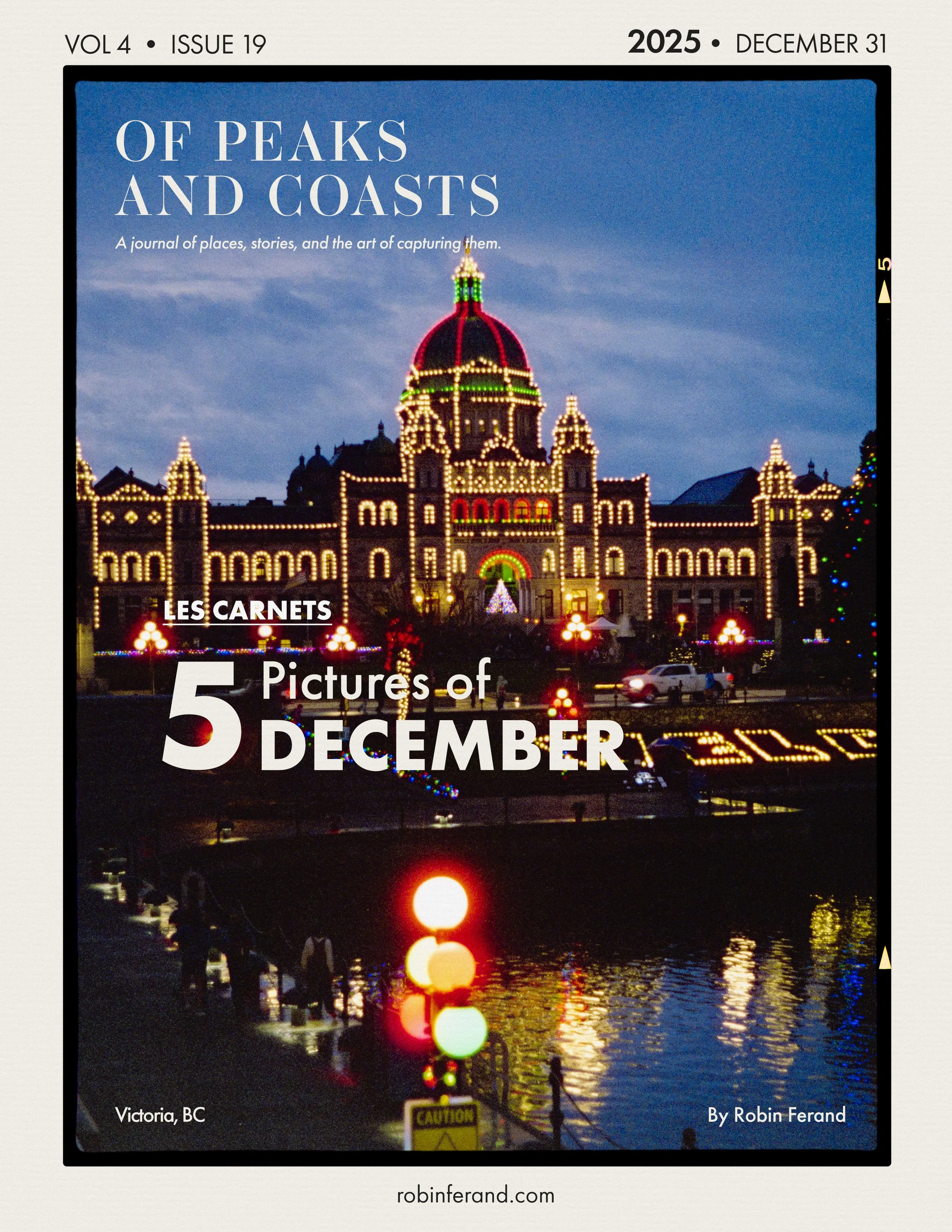
I’d been saving a few frames of that roll of Cinestill 400D for one particular photograph: the BC Parliament building at dusk. Months earlier, while sailing the World Wide Web for old Kodachrome slides of British Columbia from the 60s to the late 90s, I found a small archive of images, and one frame caught my attention: The Parliament building at blue hour, shot on Kodachrome 64. At first glance, it looked like it was shot yesterday, as very little had changed over the decades, except that the pine tree in front had grown considerably and the lawn lights weren’t there yet, but the bones of the place were the same.
What struck me most wasn’t just the characteristic colours of Kodak slide film, but the fact that it had been captured on ISO 64 slide film. By today’s standards, that would be categorized as a slow stock. Instead, we’d tend to rely on Kodak Portra 800, Cinestill 800T, Ilford Delta 3200, or even the high-ISO capabilities of digital sensors. Back then, photographers didn’t have such a luxury. 200 ISO was considered a medium-speed film, and 400 ISO a fast-speed film. Yet they were still able to capture detailed low-light scenes with a mere 64 ISO. It also reminded me of that time last year when I was going over and scanning slide film shot by my grandfather and father. There were also city scenes at dusk and night. But how? After all, tripods weren’t always on hand. We managed by leaning against a car roof, a low wall, or a street pole. My dad replicated this when I asked him one evening, mentioning my finds of the day. You breathed out slowly and pressed the shutter at the end of the exhale. Hands felt steadier because they had to be, and there was no such thing as a stabilized lens or IBIS.
With that in mind, I didn’t bring a tripod to Victoria either. Instead, I rested my small ONA shoulder bag on the low stone wall along the Inner Harbour, settled the Olympus OM‑2 on top, framed the building, and switched on the self-timer. The lights traced the outline of the building, warm against the deepening blue of the sky, and the water below carried a soft smear of reflections. And once again, that bright red halation, the signature look of Cinestill stocks. Once the roll was done, I retook the same scene, handheld, with the iPhone 17 Pro. Convenient. Almost too easy.
V) The Tugboats of Cowichan Bay
2025 • December 15 | Cowichan Bay, BC
Shot on Olympus OM2 - 50mm f/1.7 - Ilford HP5 +1
Heading north from Victoria, we left the main highway to chase a slower road through Shawnigan Lake. Fallen branches and bits of storm debris scattered the way, remnants of that storm cell still battering southern Vancouver Island. By late afternoon, we wound down into Cowichan Bay, a place I’d wanted to visit for years but always missed.
Upon driving down the eponym road that led to the bay, the harbour looked like a slice of an earlier decade. Wooden docks, weathered shacks, fishing boats tied three deep, the air ringing with rigging tapping against masts, and there was a cluster of boat houses straight out of “Sleepless in Seattle. It was the kind of quiet, self-contained seaside town filmmakers adore. You could frame any corner and find a story waiting.
We walked down the wharf and could hear the sea lions barking in the distance, and now and then their heads surfaced between the boats, and we saw them sitting on the outer pier, away from humans’ reach.
I always had a thing for harbour. From a very young age, I remember walking down the numerous marinas with my dad in the south of France. We would look at the sailboats, mention which ones we’d like, and sometimes converse with the sailors there, who were never shy about sparking a conversation when they saw our attraction to sailboats.
Here in British Columbia, most harbours are fenced off, and security signs replace handshakes. That’s why these few open ones feel precious. I walked the dock in slow loops, capturing the small details of the harbour: ropes hanging from the pier, stacked crab traps drying in the sun, and the reflections of tugboats resting against their moorings, their hulls gleaming, oily, dark, and worn out from years at sea. I framed the thick rope coiled on one stern, and it looked like a pale two-headed serpent folding itself over a woven basket.
Final Thoughts
These five photographs define the month for me. Not the boldest, not the most dramatic, and I know I shot more that would probably perform much better on social media, yet I chose these five. It’s easy to chase perfect compositions or hope for a “banger.” Yet sometimes, the real point lies in those unguarded seconds when the impulse to photograph feels like recognition, as if something in front of you stirs a memory before you even know why. That’s what these frames are to me: small pieces of December 2025, carried forward in silver and pixels alike.