
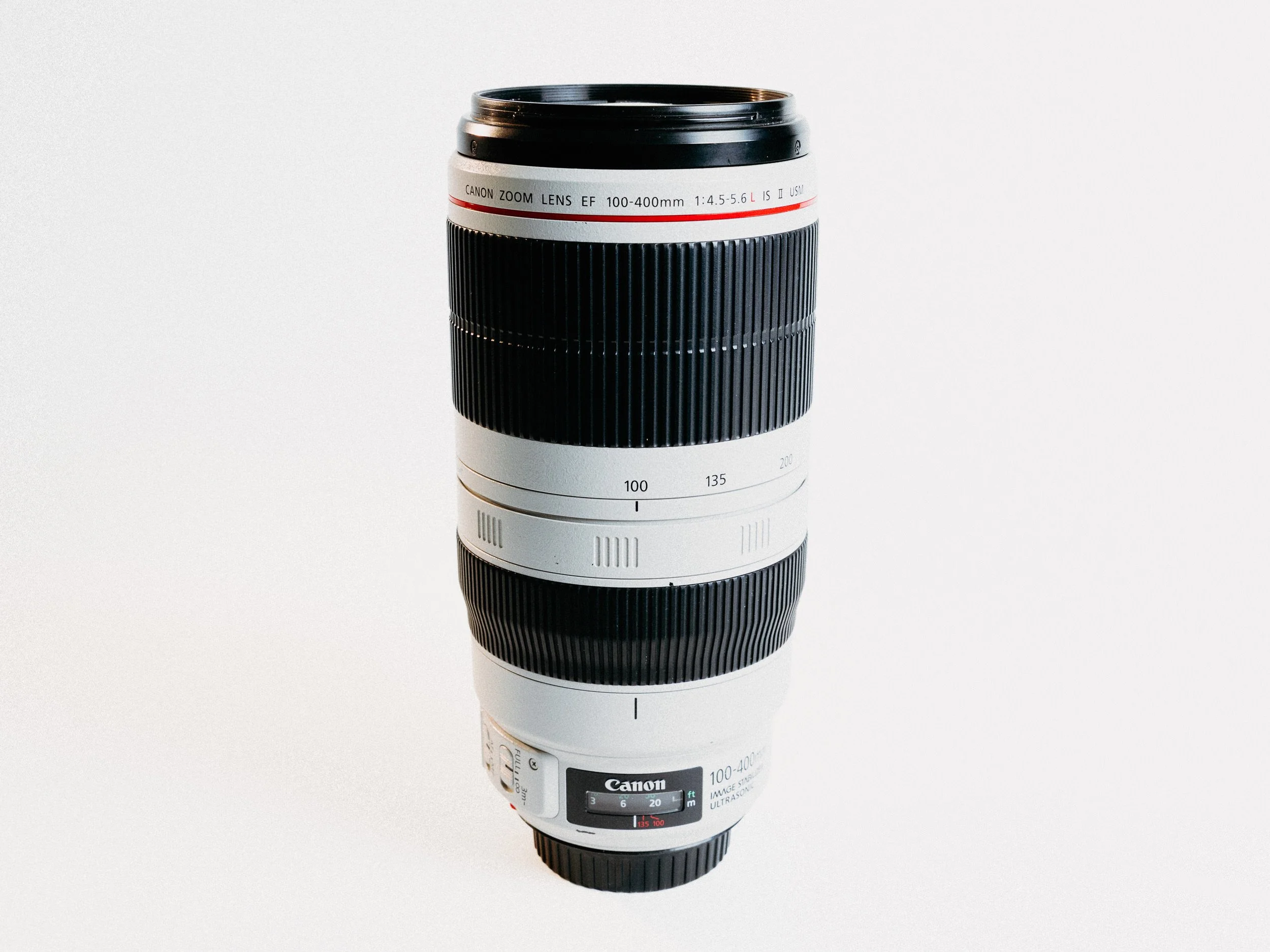
Canon EF
100-400mm f/4.5-5.6 IS L II
CANON EF 100-400mm f/4.5-5.6 IS L II
-
100-400mm full-frame L-series telephoto zoom for wildlife, sports, travel, and compressed landscapes.
21 elements in 16 groups, with inner focusing and ring USM autofocus.
Optical Image Stabilizer rated up to about 4 stops, with tripod detection.
Close focus down to 0.98m / 3.2 ft, with up to about 0.31x magnification.
77mm filter thread, weather-resistant L-series build, and rotating zoom design.
Compatible with EF Extender 1.4x III, becoming roughly 140-560mm f/6.3-8.
-
Since its 2014 release, the Canon EF 100-400mm f/4.5-5.6L IS II has been one of my dream lenses. I finally found a used copy in excellent condition in France at the end of 2021. For a year or two, between 2021 and 2023, the used market was actually pretty good for this lens. I think it lined up with people moving to the RF 100-500mm L.
It used to be one of Canon’s more difficult lenses to produce, and at its core, it feels like a refined 70-200mm lens paired with a 2x extender, all in one package. The image quality is still excellent for a lens released more than a decade ago, it adapts perfectly to RF bodies, and I have made some of my favourite wildlife images with it.
I recently paired it with the EF Extender 1.4x III for extra reach. On RF bodies, it gives me roughly a 140-560mm f/6.3-8 setup. However, it is easier to miss focus with the extender, especially at the long end or in backlit situations, but the image quality remains quite good — especially if, like me, you do not necessarily want an over-crisp image.
I am keeping this lens because, beyond all the advantages above, it works across both sides of my Canon kit: digital RF bodies with an adapter, and older EF bodies like my Canon Elan 7. That makes it more flexible than a native RF-only lens for the way I shoot.
The Good:
Excellent focal range for wildlife, distant details, outdoor events, and landscape compression.
Strong image stabilization makes handheld telephoto work much more realistic.
L-series build, weather resistance, and reliable autofocus suit field use.
Close-focus ability is unusually good for this class of lens.
Works well adapted to Canon RF bodies.
The Bad:
Variable f/4.5-5.6 aperture is not ideal for low light or strong subject isolation.
Still large and heavy compared with more modern RF telephotos.
EF-to-RF adapter adds length on mirrorless bodies, especially when paired with an extender on top.
Not a replacement for a fast 300mm or 400mm prime when light and subject separation are critical.
With the 1.4x extender, autofocus on older DSLR/film bodies can become limited or manual focus only.
-
Get it if 70-200mm starts to feel too short.
Get it if you need one flexible long lens instead of several primes.
Get it if you are staying invested in EF lenses adapted to RF.
Get it if you want a long lens that can still work on older EF film or DSLR bodies.
Pass if you want to specialize in bird photography and need more than 400mm most of the time.
Pass if you want the latest RF option; the RF 100-500mm L is lighter, native to RF, and has more reach, but it is also more expensive.
-
For the past year or so, the EF 100-400mm L II has been going up in price on the used market. You can still find good deals from people who upgraded to RF, but clean copies aren't as cheap as they were for a brief period in 2021-2022. Bird and wildlife photographers often take excellent care of their gear (mine looked mint).
As of 2026, this lens appears to be discontinued, so the used market is what is available now. Canon will eventually stop servicing it, but that should not be an immediate concern.
If you want an RF lens but are not ready to invest in the RF 100-500mm L, the smaller RF 100-400mm IS USM is also a good option. It is lighter and more affordable, but it is not the same class of lens.